- Home
Edition
Africa Australia Brasil Canada Canada (français) España Europe France Global Indonesia New Zealand United Kingdom United States Edition:
Global
Edition:
Global
- Africa
- Australia
- Brasil
- Canada
- Canada (français)
- España
- Europe
- France
- Indonesia
- New Zealand
- United Kingdom
- United States
Academic rigour, journalistic flair
 Antonio Scorza/COP30
Are UN climate summits a waste of time? No, but they are in dire need of reform
Published: December 1, 2025 2.07am GMT
Arthur Wyns, The University of Melbourne
Antonio Scorza/COP30
Are UN climate summits a waste of time? No, but they are in dire need of reform
Published: December 1, 2025 2.07am GMT
Arthur Wyns, The University of Melbourne
Author
-
 Arthur Wyns
Research fellow, The University of Melbourne
Disclosure statement
Arthur Wyns has received funding from the University of Melbourne, the World Health Organization, and the World Bank.
Partners

University of Melbourne provides funding as a founding partner of The Conversation AU.
View all partners
DOI
https://doi.org/10.64628/AA.cjf4a9x79
https://theconversation.com/are-un-climate-summits-a-waste-of-time-no-but-they-are-in-dire-need-of-reform-270457 https://theconversation.com/are-un-climate-summits-a-waste-of-time-no-but-they-are-in-dire-need-of-reform-270457 Link copied Share articleShare article
Copy link Email Bluesky Facebook WhatsApp Messenger LinkedIn X (Twitter)Print article
The United Nations’ global climate summit has finished for another year. Some progress was made in Brazil on climate finance and adaptation. But efforts to end reliance on fossil fuels were stymied by – you guessed it – fossil fuel powers.
It left many observers with a question: is this really the best we can do? Nearly every country (except the United States) joined the COP30 summit in the Brazilian city of Belém. The meeting showed the best and the worst of multilateralism – when countries try to address global problems beyond the capacity of an individual nation.
On one hand, COP30 managed to draw world leaders to the heart of the Amazonian rainforest to highlight the global issue of deforestation. And it maintained political momentum on climate action despite an unprecedented year of geopolitical turbulence, wars, finance cuts and UN job losses.
But the protracted climate negotiations failed to acknowledge the main drivers of climate change in the final text, including fossil fuels. And the UN’s decision-making process broke down on the final day of the summit. Many countries objected to the opaque and undemocratic way Brazil pushed through the final decision text.
A decade on from the Paris Agreement, there’s a growing sense climate summits are disconnected from real-world climate action. This begs the question: are the UN climate negotiations still fit for purpose? Or do they need to be reformed?
Consensus is too slow
Unlike most UN meetings, climate negotiations don’t use a majority voting rule, where the proposal with the most votes wins. Instead, decisions are always adopted by consensus. Every nation has to agree. This is a historical quirk that has been in place since COP1, where members of the Organization of the Petroleum Exporting Countries (OPEC) successfully argued that all UNFCCC decisions should be taken only by consensus.
Focusing on consensus has arguably led to slower, more incremental progress on global climate action. There’s a long history of climate summit decisions being abandoned, watered down or delayed because of a handful of objections.
This means climate summits reflect the lowest common denominator. Decisions must be acceptable to every single country, including countries deeply dependent on revenue from fossil fuel exports.
The reliance on consensus led to political drama at the COP30 closing plenary. Some African and Latin American countries, and the European Union, raised objections after Brazil rattled through the adoption of watered-down COP decisions without allowing other countries to intervene.
The introduction of a majority voting rule in the UN climate negotiations – a common practice across the UN – could effectively unblock this situation and drive meaningful political change on climate.
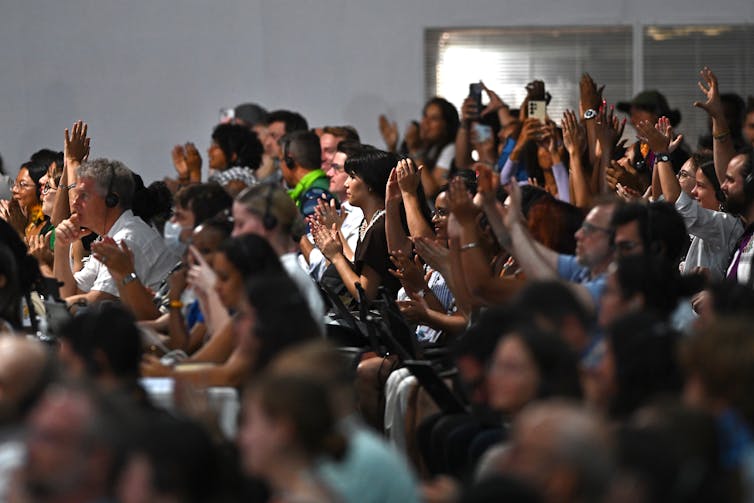 Attendees applaud during a COP30 summit session in Belem, Brazil, 2025.
Andre Borges/AAP
Attendees applaud during a COP30 summit session in Belem, Brazil, 2025.
Andre Borges/AAP
Refocus on implementation
Over the past ten years, government representatives have negotiated the Paris Agreement rulebook. COP30 finalised the only remaining work on global carbon markets and how to measure global progress on adaptation.
With the rules now fully established, climate summits have shifted into the implementation phase. At COP30, this manifested as a flurry of new climate initiatives and coalitions, such as the launch of a new fund to end deforestation, commitments to tax luxury travel, and efforts by a group of countries to speed up the phase-out of fossil fuels.
These are a sign governments are moving away from negotiating global consensus statements and instead progressing climate action in smaller “coalitions of the willing”. Future climate summits might need to redesign their format so they are less focused on negotiating international rules and more geared towards implementation. This would provide a chance for improved collaboration, accountability and the tracking of progress.
Clamping down on vested interests
A third area ripe for reform is the presence of vested interests. Fossil fuel industry lobbyists freely participate at COPs and have a long history of undermining ambition. By one account, COP30 saw the participation of 1,600 fossil fuel lobbyists. Previous Australian governments have promoted fossil fuel companies such as Santos at climate summits.
Media reports have revealed how the COP28 and COP29 presidencies of the United Arab Emirates and Azerbaijan leveraged their roles to facilitate oil and gas deals, while COP30 relied on a PR firm that also works for oil and gas company Shell.
A step towards reform was taken in September when the UN climate secretariat announced new voluntary disclosure requirements for people attending the climate talks. Additional reforms could include mandatory disclosure requirements, clear rules for managing conflicts of interest and a code of conduct with transparency criteria.
The best we have
Many proposals have been put forward for improving how COPs work, from streamlining the bloated negotiation agendas to providing clearer expectations on the role of COP presidencies. These proposals recognise the many flaws of the global climate summits and point to the need for a major overhaul.
But this does not mean we should get rid of COPs altogether. They remain a crucial tool for driving political decision-making and international collaboration on the largest global challenge of our time. For example, new figures released by the UNFCCC at the start of COP30 showed that the global emissions curve is beginning to bend downwards for the first time, while a scenario without the Paris Agreement in place saw emissions continue to rise by 20–48% in the next ten years.
The global transformation of energy systems and economies is a deeply political process and requires an ongoing political platform. Importantly, COPs are also the only political space where the smallest island countries carry the same weight as the most powerful economies.
Despite being messy and complicated affairs, COPs will remain necessary for years to come.
- Fossil fuels
- Climate change
- Climate
- Environment
- Cop30
Events
Jobs
-
 Lecturer/Senior Lecturer - Electrical Engineering
-
University Lecturer in Early Childhood Education
-
Case Specialist, Student Information and Regulatory Reporting
-
Lecturer in Paramedicine
-
Associate Lecturer, Social Work
 Lecturer/Senior Lecturer - Electrical Engineering
 University Lecturer in Early Childhood Education
 Case Specialist, Student Information and Regulatory Reporting
 Lecturer in Paramedicine
 Associate Lecturer, Social Work
- Editorial Policies
- Community standards
- Republishing guidelines
- Analytics
- Our feeds
- Get newsletter
- Who we are
- Our charter
- Our team
- Partners and funders
- Resource for media
- Contact us
-
-
-
-
Copyright © 2010–2025, The Conversation